The Last 5% Is Where Songs Go to Die
I speak to a lot of artists who have songs that are almost ready for mixing. Not half-finished, not still waiting for someone to write a chorus, just almost ready. They only need to rerecord one vocal, change a guitar sound and maybe add something to the second verse, and then they’ll send it right over. All perfectly reasonable, except one small job becomes three, those three become seven, and six months later the song is still sitting on the same hard drive while its creator auditions another snare because the previous 46 apparently weren’t quite right. This is the final 5% of making a record, the mysterious place where an artist can do an extraordinary amount of work without ever getting any closer to finishing it or having anything to show for all that effort.
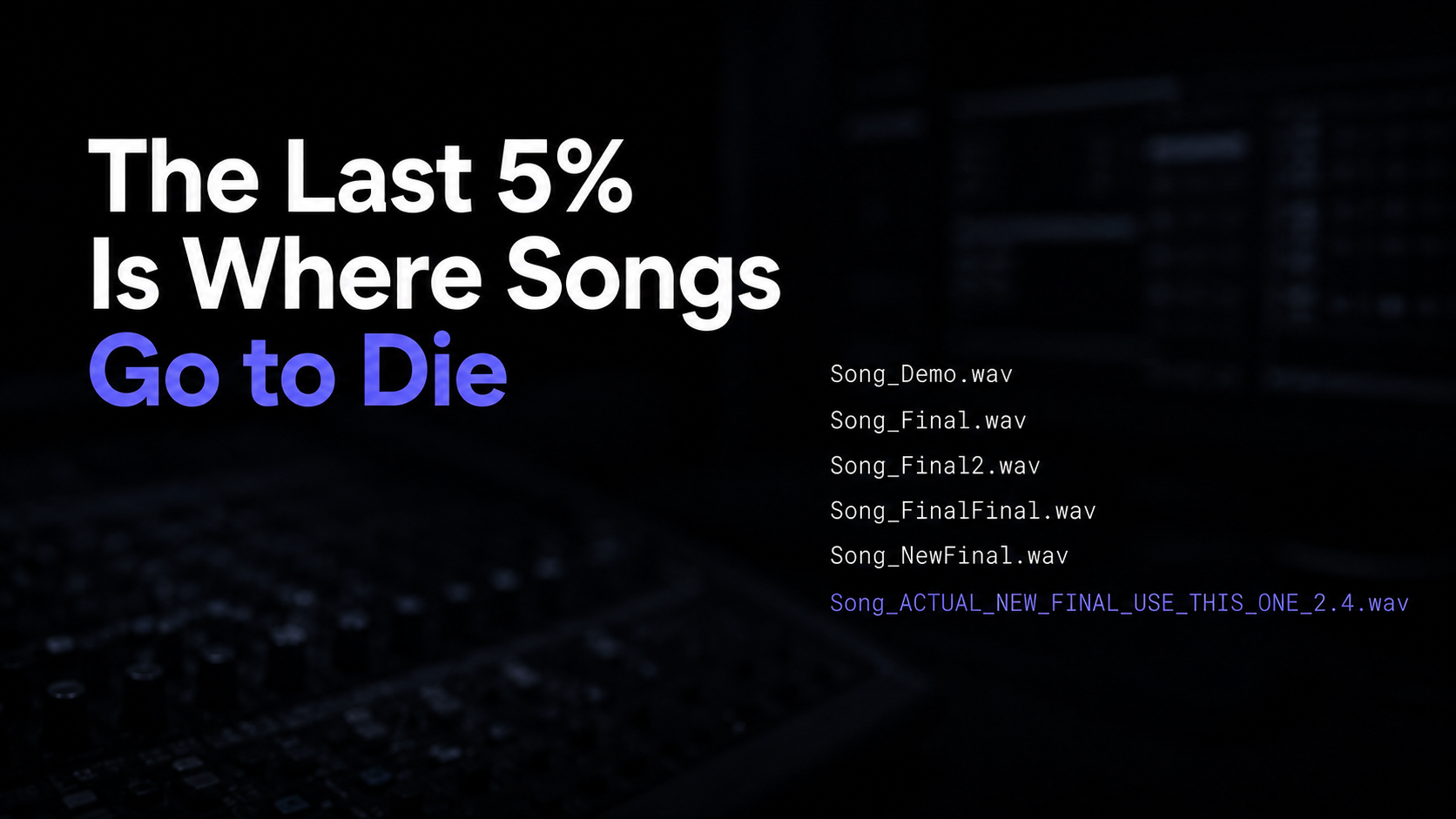
You can usually tell when a song has entered this phase by looking at the filenames. It starts with ‘Song_Demo.wav’, then comes ‘Song_Final.wav’, ‘Song_Final2.wav’, ‘Song_FinalFinal.wav’, ‘Song_NewFinal.wav’ and eventually ‘Song_ACTUAL_NEW_FINAL_USE_THIS_ONE_2.4.wav’.
Spoiler alert: none of these files are final. At some point, ‘final’ stops meaning final and becomes more of a cry for help. If you’re choosing between six versions whose main difference is an extra backing vocal in the second chorus and nobody, including you, can reliably remember which one they preferred, there’s a fair chance you’re no longer improving the song and are just continuing to touch it.
The early stages of writing and producing music are usually much easier to judge. You write a chorus, find a groove, record some guitars and gradually hear something that used to exist only in your head becoming an actual song. The decisions are big enough to feel, and they feel good! Once all the main pieces are there, though, your attention starts drifting towards smaller and smaller details. These do not feel so good. A synth sound that no normal person will ever consciously notice becomes the sole focus of your afternoon. You replace it, decide the old one had more character, bring the old one back, then spend another hour wondering whether the new one sat better. The fact that you can hear a difference doesn’t mean one version is better, and it definitely doesn’t mean anyone listening in the car on the way to work will care.
This is where improvement turns into rearranging the deck chairs on the Titanic (without the impending death). The guitar gets rerecorded with a slightly different tone, the second verse loses four bars and then gets them back, the snare goes through another round of auditions and a perfectly good vocal is binned because one word could possibly have been sung with 3% more longing. The song keeps changing, so it feels as though progress is being made, but often it just ends up back where it started wearing a different synth preset. Keeping it unfinished also has one enormous advantage: nobody can judge it yet. As long as you’re still working on the song, every possibility remains open and you can continue imagining the flawless version it might eventually become. Once you call it finished and send it out into the world, that’s it. You’ve made the decisions. Horrifying.
There’s a brilliant moment about this in the 2011 documentary 6 Days to Air: The Making of South Park, which follows Trey Parker, Matt Stone and their team making an entire episode of South Park in six days. It’s written, recorded, animated, edited and delivered only hours before it goes on television, so they don’t have the option of sitting with it for another month to see whether a joke in scene four could be 2% funnier. Trey Parker admits that he always wishes he had another day, but he also knows that without the deadline he could spend weeks deciding the episode still wasn’t ready. As he puts it, “All you do is start second-guessing yourself and rewriting stuff, and it gets over-thought, and it would have been 5% better.”
That last bit has always stuck with me. Even if another four weeks really would make your song 5% better, is that necessarily worth it? You could’ve finished another song in that time. You could’ve made several recordings, learned something from each of them and carried all of that into the next one. Instead, you’ve spent the month deciding whether the pre-chorus should be two bars longer and switching between ‘FinalFinal.wav’ and ‘NewFinal.wav’ to determine which contains the superior tambourine. I’m obviously not suggesting you copy the South Park production schedule, write an album on Monday and send me the multitracks on Sunday morning. Their working week looks completely deranged. The useful part is that they have a finish line they can’t negotiate with. At some point, the episode has to go on television, whether Trey Parker thinks he could make it another 5% better or not. Most musicians don’t have anything forcing that decision, so the final 5% can continue for as long as they’re prepared to let it.
I should also make it clear that I’m not writing this as some enlightened studio professional who has heroically defeated perfectionism. I get it because I’m literally the worst when it comes to this with my own music. When I’m mixing and mastering someone else’s music, I have no problem giving it the focus and attention it deserves, making decisions confidently and getting it over the finishing line by the deadline. By the time a song reaches me, the artist has decided what it is and I have a clear job to do: understand what they’re aiming for, bring the production together and make it sound as good as it possibly can. I’m close enough to care about every detail, but far enough away to tell whether changing one of them is actually helping.
However, on the occasions when I’ve worked on my own music (no, I won’t be sharing a link), it’s been a completely different story. Suddenly I’m not just the engineer, I’m also the writer, performer, producer, critic and deeply unhelpful but handsome committee of one. I’ve created the stupid filenames, made the tiny changes, changed them back and then wondered whether the first change might actually have been better. I know how easy it is to disappear down that hole, which is also why I know that technical skill isn’t always the problem. Sometimes you’ve just been living inside the song for so long that you’re no longer remotely qualified to tell when it’s finished.
Now, this doesn’t mean you should send a half-written song off for mixing and ask the engineer to locate a second verse somewhere inside the hi-hat track. The important production decisions still need to be made. The song should be written, the arrangement should feel right, the performances you want should be recorded and anything you genuinely intend to change at the production stage should be changed. What it doesn’t need to do is match some abstract idea of a perfect version of the song that you can’t articulate but know exists.
A useful question to ask when you’re fiddling with something for the 19th time is: what problem am I actually trying to solve? If you can answer that clearly, crack on. If the chorus genuinely needs another part, try one. If the lyric in the second verse isn’t saying what you want it to say, rewrite it. If there’s an audible lawnmower halfway through the vocal take, either rerecord it or accept that your new artistic direction is garden machinery. But if you can’t identify a real problem and you’re simply cycling through alternatives in the hope that one of them will produce a sudden feeling of absolute certainty, version 20 probably isn’t going to provide it.
There will always be something else you could change, and there’s no magical point at which every decision becomes objectively correct and the music gods descend to certify your production as 100% complete. A finished song isn’t one that couldn’t possibly be changed. It’s one where the writing, arrangement and performances communicate what you want them to communicate, and further tinkering is more likely to keep the record trapped on your hard drive than make anyone enjoy it more. At some point, you have to decide that this is the song, export the rough mix and multitracks, and send them over for mixing and mastering. Just make sure you send the correct final version (it was ‘REDOSong_ACTUAL_NEW_FINALFINAL_USE_THIS_ONE_7.3.wav’).